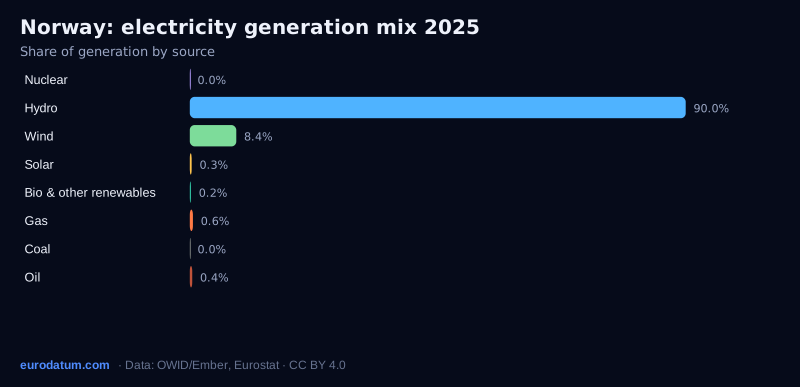
In 2025, Norway generated 160.8 TWh of electricity and used 137.7 TWh. Hydro was the largest source at 90% of generation.
28gCO₂/kWh grid intensity#1 of 30 · EU 210
99%low-carbon electricityEU 71%
0.097€/kWh industrial, 2026 H1#4 cheapest · EU 0.135
62€m/yr power for 100 MW AI campus25 kt CO₂/yr
Grid access outlook (editorial)More room
Hydro power, cool climate
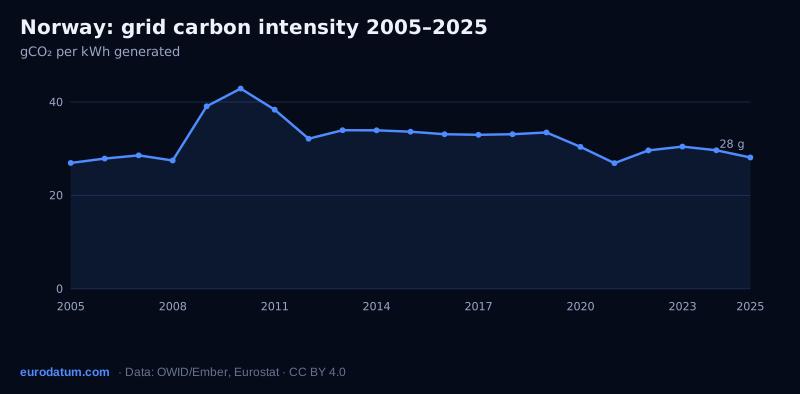
99% of its electricity came from low-carbon sources (nuclear and renewables), above the EU-27 average of 71%. Grid carbon intensity was 28 gCO₂/kWh, ranking #1 of 30 European countries (1 = cleanest), down 16% since 2015. Industrial users consuming 20–70 GWh a year paid €0.097/kWhexcluding VAT in 2026 H1, less than the EU-27 average of €0.135 (#4 cheapest of 28). At €0.071/kWh, a 100 MWAI data center running at full load (876 GWh a year) would pay about €62 million a year for electricity and, on the average grid mix, be responsible for about 25 kt of CO₂.
Electricity generation mix, 2025
Source
Norway
EU-27
Nuclear
0.0%
23.3%
Hydro
90.0%
11.7%
Wind
8.4%
17.1%
Solar
0.3%
13.1%
Bio & other renewables
0.2%
5.8%
Gas
0.6%
16.7%
Coal
0.0%
9.2%
Oil
0.4%
3.1%
Grid carbon intensity, 2005–2025
gCO₂ per kWh of electricity generated. Lower is cleaner.
Wind and solar share of generation
Industrial electricity price, 2019–2026 H1
Non-household consumers using 20–70 GWh/yr, excluding VAT and recoverable taxes, €/kWh.
Infrastructure & market
49colocation facilities (PeeringDB)
18data centers mapped in OpenStreetMap
–HV substations (pending)
9,277MW cross-border capacity, 2030 grid (TYNDP)
111€/MWh avg wholesale price, last 12 months
54hours with negative prices, last 12 months
0cooling degree days (5-yr avg)
743kWh/kWp solar yield at the capital (PVGIS)
Norway has 49 colocation facilities listed in PeeringDB. Over the last 12 months the average day-ahead wholesale price was €111/MWh(bidding zone NO2 only), with 54 hours of negative prices. The TYNDP 2030 starting grid gives it about 9,277 MW of cross-border transmission capacity. Its climate averaged 0 cooling degree days a year (Eurostat), a rough guide to how hard data center cooling has to work.
 Country power profile · NO